
Inland Revenue Board of Malaysia's FAQs released on January 28, 2025
马来西亚内陆税收局于2025年1月28日发布的 FAQs

English article
Inland Revenue Board of Malaysia's FAQs released on January 28, 2025, the affected updates are mainly focused on Issues 8, 11, 55, and 66 as compared to previous releases.
The following are the detailed descriptions of these issues:
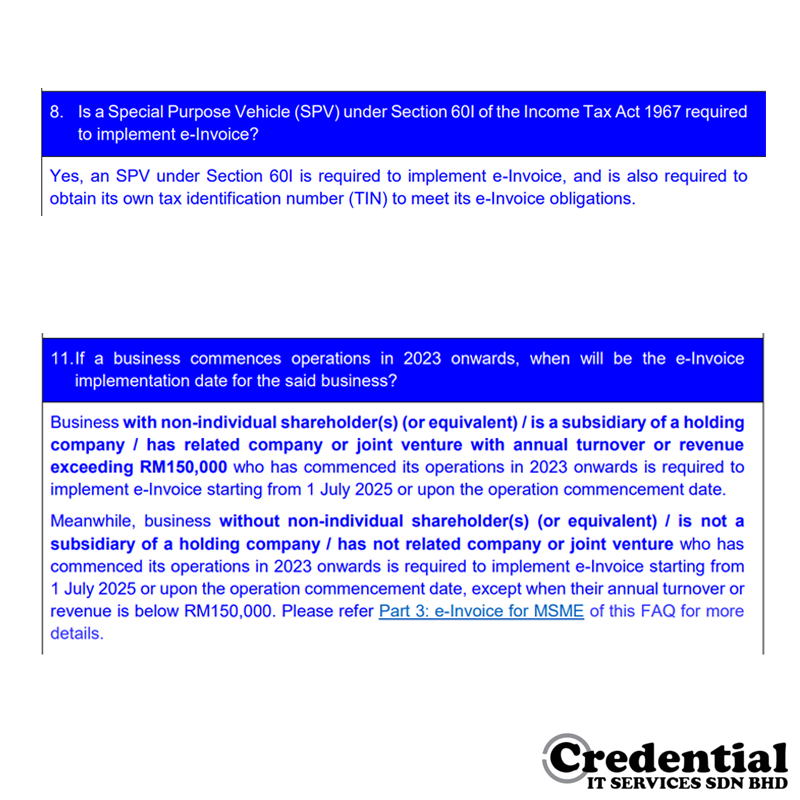
1. Question 8: Is a Special Purpose Vehicle (SPV) under Section 60I of the Income Tax Act 1967 required to implement e-Invoice?
Yes, an SPV under Section 60I is required to implement e-Invoice, and is also required to obtain its own tax identification number (TIN) to meet its e-Invoice obligations.
2. Question 11: If a business commences operations in 2023 onwards, when will be the e-Invoice implementation date for the said business?
Business with non-individual shareholder(s) (or equivalent) / is a subsidiary of a holding company / has related company or joint venture with annual turnover or revenue exceeding RM150,000 who has commenced its operations in 2023 onwards is required to implement e-Invoice starting from 1 July 2025 or upon the operation commencement date.
Meanwhile, a business without non-individual shareholder(s) (or equivalent) / is not a subsidiary of a holding company / has no related company or joint venture who has commenced its operations in 2023 onwards is required to implement e-Invoice starting from 1 July 2025 or upon the operation commencement date, except when their annual turnover or revenue is below RM150,000.
Please refer to Part 3: e-Invoice for MSME of this FAQ for more details.
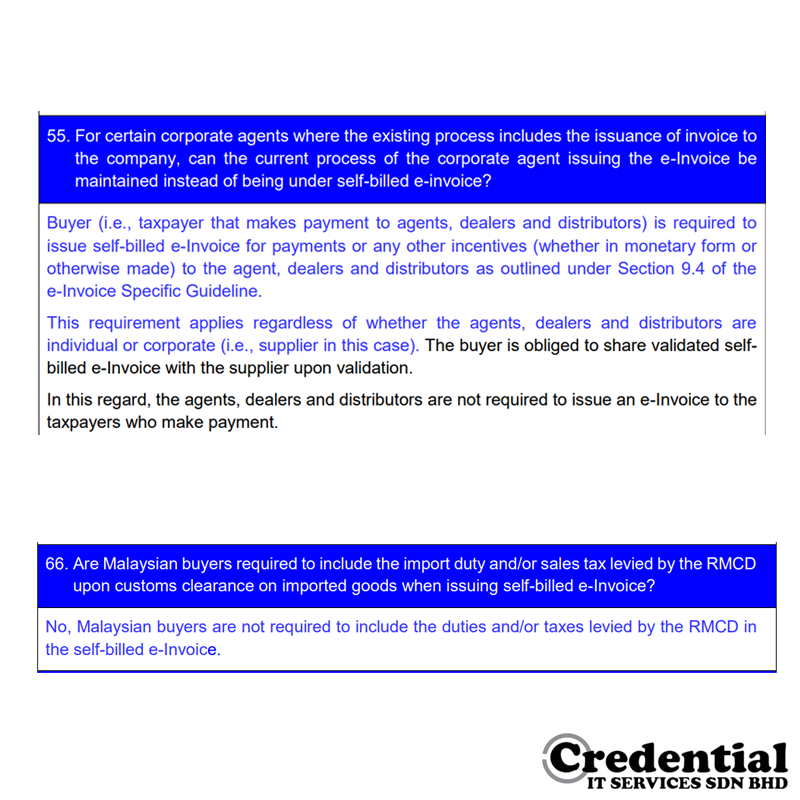
3. Question 55: For certain corporate agents where the existing process includes the issuance of an invoice to the company, can the current process of the corporate agent issuing the e-invoice be maintained instead of being under self-billed e-invoice?
Buyer (i.e., a taxpayer that makes payment to agents, dealers and distributors) is required to issue self-billed e-Invoice for payments or any other incentives (whether in monetary form or otherwise made) to the agent, dealers and distributors as outlined under Section 9.4 of the e-Invoice Specific Guideline.
This requirement applies regardless of whether the agents, dealers and distributors are individual or corporate (i.e., supplier in this case). The buyer is obliged to share the validated self-billed e-invoice with the supplier upon validation.
In this regard, the agents, dealers and distributors are not required to issue an e-invoice to the taxpayers who make payments.
4. Question 66: Are Malaysian buyers required to include the import duty and/or sales tax levied by the RMCD upon customs clearance on imported goods when issuing self-billed e-invoices?
No, Malaysian buyers are not required to include the duties and/or taxes levied by the RMCD in the self-billed e-invoice.
中文内容
马来西亚内陆税收局于2025年1月28日发布的 FAQs,相较于之前的版本,受影响的更新内容主要集中在问题8、11、55和66。
以下是这些问题的详细说明:
1. 问题8:
- 更新内容:关于根据《1967年所得税法》第601条设立的特殊目的公司(SPV)是否需要实施电子发票。
更新内容指出,SPV需要实施电子发票,并且需要获得自己的税务识别号(TIN)以满足电子发票的义务。
2. 问题11:
- 更新内容:关于2023年及以后开始运营的企业的电子发票实施日期。
更新内容指出,若企业有非个人股东(或同等实体)或为控股公司的子公司,且年营业额或收入超过15万令吉,则需从2025年7月1日或运营开始之日起实施电子发票。
3. 问题55:
- 更新内容:关于某些公司代理的现有流程是否可以在电子发票实施后继续维持。
更新内容指出,无论代理是个人还是公司,买方(即向代理、经销商和分销商付款的纳税人)都需要签发自开电子发票(self-billed e-Invoice)。
4. 问题66:
- 更新内容:关于马来西亚买家在签发自开电子发票时是否需要包括由马来西亚皇家海关局(RMCD)征收的进口关税和/或销售税。
更新内容指出,马来西亚买家无需在自开电子发票中包括由RMCD征收的关税和/或税款。
MyTax Info
More practical e-Invoice updates